
Understand the rules before joining a live table
 Available in US
An overview of licensing, live table formats, mobile play and the limits of predicting roulette results.
New Zealand’s 2026 Rules for Live Roulette
The legal position for live dealer roulette in New Zealand changed during 2026. The Online Casino Gambling Act 2026 took effect on 1 May, beginning a transition from a market without domestic online casino licensing to a regulated system. The change does not mean that every site serving Kiwi players is already licensed in New Zealand. The new regime is being phased in, and the distinction between offshore access and domestic approval remains important.
Before the Act, online casinos based overseas were not licensed or supervised by a New Zealand regulator. The Gambling Act 2003 prohibited online casinos from being based in New Zealand, but it did not prevent Kiwi players from accessing gambling websites operated offshore. That position allowed access to live roulette at international sites, while leaving customers without domestic government recourse if a dispute arose with an offshore provider.
The 2026 Act establishes the country’s first domestic licensing framework for online casino gambling. Its scope includes live dealer tables, which sit in the same licensing category as online pokies and digital table games. In other words, a live roulette table is covered as part of the online casino sector rather than being treated as a separate type of gambling licence.
Choosing a live dealer roulette site means considering both the games on offer and the practical details you can verify about an operator. Use these short verdicts as a starting point when reviewing options for New Zealand players.
-
7Bit Casino
- License
- Tobique Gaming Commission, licence no. 0000091
7Bit Casino lists a Tobique Gaming Commission licence, number 0000091. This provides a specific licensing detail to check when considering the operator.
-
Ricky Casino
- License
- Tobique Gaming Commission, licence no. 0000002
Ricky Casino lists a Tobique Gaming Commission licence, number 0000002. The licence information is the available concrete detail for this operator.
-
N1 Casino
- License
- Malta Gaming Authority, licence no. MGA/B2C/394/2017
N1 Casino lists a Malta Gaming Authority licence, number MGA/B2C/394/2017. This gives readers a specific regulatory detail to verify.
-
BitStarz
- License
- Curaçao Gaming Authority, licence no. OGL/2024/165/0185
BitStarz lists a Curaçao Gaming Authority licence, number OGL/2024/165/0185. Its licence details are the available factual point to consider.
-
Play Grand
- License
- Malta Gaming Authority, licence no. MGA/B2C/370/2017
Play Grand lists a Malta Gaming Authority licence, number MGA/B2C/370/2017. Readers can use this specific licensing information as part of their checks.
-
Wintino
- Payout speed
- 1-3 business days
Wintino has a stated payout speed of 1–3 business days. This gives readers a concrete payment detail to consider.
-
Zotabet
- License
- 07017519840
- Payout speed
- 1-3 business days
Zotabet lists licence number 07017519840 and a payout speed of 1–3 business days. These are the available concrete details to consider.
-
Lamabet
- Payout speed
- 1-3 business days
Lamabet has a stated payout speed of 1–3 business days. This is the available practical detail for readers assessing the operator.
-
Neospin
- License
- Tobique Gaming Commission, licence no. 0000064
Neospin lists a Tobique Gaming Commission licence, number 0000064. This specific licensing information is the available factual point to check.
The Act provides for a maximum of 15 licences across that sector. The transition began on 1 May 2026, but the licensing system is not expected to be fully operational until 2027. Until the new regime reaches that stage, the market is governed by transitional provisions rather than a fully functioning set of domestic licences.
Those provisions allow online casinos that were already serving people in New Zealand before 1 May 2026 to continue operating during the transition, through 1 December 2026. The cutoff changes the position: from that date, the 15 approved operators are the only ones permitted under the new rules to accept Kiwi players. Operators that have not applied must stop serving the New Zealand market by then. A pending application can allow an operator to continue while the Department of Internal Affairs considers it, but that does not permit advertising during the transition. If an application is declined, the provider must leave the market.
This timetable matters when assessing an online live roulette dealer site. A website’s continued availability during the transition should not be confused with approval under the future licensing regime. Nor does the presence of live tables, or the ability to open an account, establish that the operator has a New Zealand licence. The Act creates a route to domestic approval, but the transitional period means that different providers may be in different regulatory positions at the same time.
New Zealand does not have a separate Kiwi-specific licence. The relevant domestic framework is for online casino gambling as a sector, and live roulette falls within it alongside other covered casino games. The cap of 15 applies to licences for that sector; it does not create a separate allocation of licences for roulette tables.

Offshore access remains a distinct issue from local licensing. Kiwi players are not prohibited from visiting offshore platforms, and they may play live dealer games at international gambling sites. That continuing access does not make an offshore operator licensed in New Zealand. Before the domestic regime, offshore online casinos were outside New Zealand regulatory supervision; the new framework changes the rules for providers serving the market, rather than making every overseas site locally approved.
For that reason, the regulatory status of a live roulette dealer casino should be assessed on its own terms. An offshore site should be regulated by a recognised gambling body in the jurisdiction that oversees it. Its claimed licence status can also be checked with the Department of Internal Affairs. These checks distinguish an overseas regulatory authorisation from approval under New Zealand’s developing licensing system; the two are not interchangeable.
The transition therefore involves more than a simple switch from unrestricted access to a fully licensed market. Offshore platforms remain accessible to players, while providers serving New Zealand face a pathway and deadlines under the Act. The legal position of a particular operator depends on its circumstances under those transitional rules and, as the regime develops, whether it receives domestic approval. For live dealer roulette online, the central point is that the game is within the new online casino licensing framework, but the presence of a live table alone says nothing about the operator’s regulatory standing.
Why Free Live Roulette Practice May Be Limited
Free practice is often expected in online games, but live roulette does not necessarily follow the same pattern. Live dealer games are typically unavailable in free-play form because operating a live table carries significant costs for a casino. That economic difference helps explain why a free mode may be absent even when a player is looking for a way to become familiar with roulette before wagering.
The distinction is between the apparent simplicity of trying a game and the resources required to make that trial possible. A free-play option still has to be supported by the underlying game service. For a live dealer game, the table is part of an operation with ongoing costs; those costs do not disappear because a session is offered without a stake. Free access is therefore not a default feature that can be assumed from the existence of a real-money table.
This does not mean that free live dealer roulette is impossible in every case. “Typically not available” describes a general pattern, rather than a rule that applies to every table or every casino. Availability can depend on the particular offering. The cautious conclusion is that free play may be limited, not that it is categorically absent.
The wording used to describe a free option can also obscure what is actually being offered. A practice mode would allow play without staking money; a real-money game does not become free simply because its stakes are small. Likewise, a label such as “fun mode” would matter only if the play itself did not involve a wager. The name of a mode alone is not enough to establish its terms. Before treating an option as practice, its displayed conditions need to make clear whether funds are at risk.

The same care applies to searches for a free online live dealer roulette table. The phrase expresses a reasonable aim—experiencing the game without a financial stake—but it should not be taken as evidence that such access is standard. A page or menu may refer to a live table while offering only wagering play. Conversely, a free-play label should be assessed on its stated function rather than assumed to provide the same conditions as a live table played for money.
There is also a difference between learning roulette and practising on a particular live table. General familiarity with the game can be developed without a free live session, but that does not reproduce the conditions of a specific table. A player seeking free roulette with a live dealer may therefore find that the desired combination is narrower than either “free roulette” or “live roulette” on its own. The limiting factor is not necessarily a lack of interest in practice; it is the cost of maintaining the live service.
Terms such as “challenge” or “spread bet” do not change that underlying point. They may describe a format, feature or way of presenting play, but they do not establish that a session is free. No inference about cost should be drawn from promotional-sounding labels alone. The relevant question is whether the play requires a stake, not whether the screen presents it as a challenge or a special mode.
Do
- Seek a practice mode that allows play without staking money
- Verify if the displayed conditions involve any risk to funds
Don't
- Assume that a "fun mode" or "challenge" label implies no wager is required
- Treat a real-money game as free just because the stakes are small
When a free option is not available, that absence should not be confused with a claim that practice is pointless. It means only that practice at a live table may not be offered without wagering. Nor does the presence of a real-money table prove that an equivalent free version exists. These are separate conditions, and one cannot be inferred from the other.
For Kiwi players considering live dealer roulette free play, the practical expectation should therefore remain measured: free access is not typical across live dealer games, and the operating costs of a live table provide a reason. Where a no-cost mode is presented, its terms determine whether it genuinely permits practice without a wager. Where none is offered, the available information does not justify assuming that another version of the same table can be accessed for free. The central distinction is between wanting to practise and having a free live table available; the first does not guarantee the second.
What Live Roulette Looks Like on an Online Casino
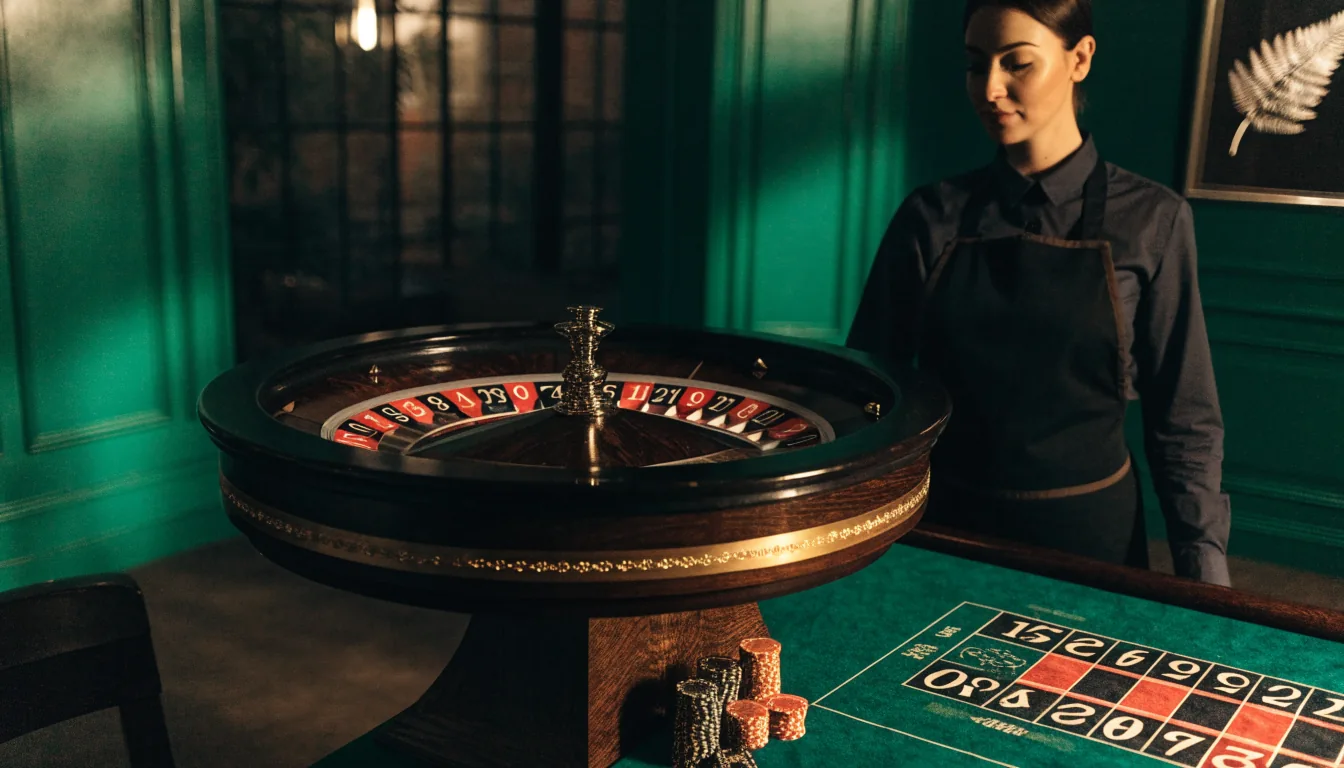
The defining feature of live roulette is a physical wheel shown in a studio setting. Rather than displaying only a digitally generated table and simulated result, an online casino live dealer roulette game presents a real wheel as part of a live table environment. The image connects the screen-based game to equipment in a studio, making the physical roulette setup central to what appears on screen.

Live dealer games use real wheels and professional studios. In roulette, that means the wheel is not merely a graphic representing the game’s central object: it is part of the real table setup. The studio provides the setting in which the table is presented, while the online interface gives the game a digital point of access. These elements distinguish a live table from software-only roulette, where the result and table are produced within the game rather than shown as physical equipment in a studio.
The difference is visual as well as structural. Software-only roulette can depict a wheel, but its image belongs to the game’s digital presentation. In live roulette, the table and wheel are physical objects within the studio environment. The screen therefore shows a real roulette setup rather than only an animation or rendered table. This distinction does not, by itself, indicate a different objective or establish anything about the chances of a particular result; it describes how the game is presented.
A live roulette screen combines the physical table view with the online casino’s interface. The table is the visible centre of the experience, while the digital setting makes the game available through an online casino. In that respect, live roulette is neither simply a video of a casino nor simply a software game: it joins physical equipment and studio presentation with an online format.
The word “live” can be understood through this connection to a real setting. A live table is built around actual equipment in a professional studio, rather than a virtual wheel operating only as part of the software. That does not mean every online roulette screen must look identical. The relevant distinction is the presence of a real wheel and studio environment, not a prescribed arrangement of visual elements.
Software-only Roulette
Results and the table are produced digitally within the game software.
Live Dealer Roulette
Features a real physical wheel and a professional dealer in a studio environment.
For someone looking for a free online live dealer roulette practice table, the appearance of the game is separate from whether a free mode is offered. A real wheel and studio describe the format; they do not establish that the table can be used without wagering. A live roulette page may therefore look different from a software-only practice game even before questions of access or play arise.
The physical setup also gives the live format a recognisable focus: the wheel is part of an actual table, and the studio is part of the game’s setting. This is the basic visual context for live dealer roulette online. It is a useful distinction when comparing what is on screen, but it does not imply that the table’s equipment changes the underlying nature of roulette as a game.
The Dealer and the Live Table
In live roulette, the dealer is part of a game broadcast as it happens. The table is located in a studio or a casino, and a video feed carries the session to players online. This differs from a software-only roulette game, where the on-screen action is generated digitally rather than shown as a real-time broadcast with a professional dealer.
The dealer’s central role is to conduct the table in view of the camera. The dealer is physically present at the game, while the online participant follows the broadcast and places bets through the casino interface. Because the feed is live, the dealer and the player are connected to the same unfolding session rather than to separate simulations. Live dealer games also allow interaction with professional dealers, making the person at the table more than a visual element in the stream.
That interaction gives live roulette a different character from automated play. The dealer provides a human presence during the broadcast, while the online interface remains the means through which a participant takes part. The distinction is useful: the dealer conducts the physical game, but the online participant does not become a player standing at the table. The experience is mediated by the live video feed.
The setting can be a dedicated studio or a casino in a particular country. In either case, the defining feature is the real-time transmission of a game involving a real dealer. The location supplies the physical context for the broadcast; it does not change the basic arrangement seen online. A professional dealer is present at the table, and the feed makes that activity available to remote participants.
The phrase “live dealer” describes this delivery model, not a promise about how immersive a particular table will feel. The broadcast creates a visual connection to a real game and enables interaction, but it remains an online experience. The dealer is seen through a screen, and participation takes place through the digital service carrying the game. This combination of a physical table and an online interface is what separates live roulette from a fully software-generated version.
A dealer’s presence also should not be confused with control over the participant’s decisions. The dealer conducts the table; participants make their own choices through the online interface. The two roles coexist within the broadcast, but they are distinct. A live roulette dealer is therefore neither merely an animated figure nor a personal adviser: the dealer is the professional conducting a real game for a live audience.
For someone considering whether live roulette feels different from automated roulette, the human element is the clearest distinction. The broadcast presents a professional dealer in a studio or casino, and the game unfolds in real time. The format can make the session feel more immediate because the action is shown as it occurs, while the option to interact adds a social dimension. Neither feature changes the fact that play is still remote and mediated by the online service.
The term “immersive” is best understood as a description of presentation rather than a measure of a roulette game’s mathematical return. A live broadcast may provide a stronger sense of being connected to a table, but the dealer’s presence alone does not establish anything about the game’s return-to-player figure. That figure belongs to the game’s mathematical terms, not to the atmosphere created by a live dealer.
Playing Live Roulette on a Smart Device
Playing live roulette on a smart device means taking part in a table game delivered through a live video feed rather than viewing only a software-generated representation. The feed connects the online game with a professional dealer and allows interaction during play. On a phone or tablet, the device therefore serves as both the screen for the broadcast and the means of engaging with the live table.
This distinction matters when considering what “mobile play” describes. It identifies the setting in which the live game is accessed, not a different form of roulette. The defining feature remains the real-time video connection and the opportunity to interact with the dealer. A smart device does not, by itself, establish how a particular table is arranged on screen or what controls are available; those details depend on the game interface.

The video element also changes the kind of attention involved. A live table is not simply a static betting screen: the broadcast carries the activity of the game, while interaction takes place alongside it. On a portable screen, those elements share the available display. The format may therefore feel different from a game presented entirely through graphics, even though the underlying purpose remains participation in roulette.
The phrase “play roulette online with a live dealer” can refer to this combination of remote access and a human-presented game. It should not be taken to mean that the dealer is physically beside the player or that a smart device creates a separate dealer service. The professional dealer is part of the live broadcast, and the player joins through the video feed.
Mobile access also should not be confused with a claim about a dedicated application. Live dealer play is defined by the broadcast and interaction, not by whether access is through an app or another interface.
For Kiwi players, the central point is that smart-device play retains the live nature of the game: a professional dealer appears through video, and interaction occurs remotely. The device changes where the game is viewed, but the live feed remains the link between the player and the table. That is the relevant distinction when assessing mobile live roulette, without assuming that every service presents the experience in the same way.
Roulette Results, Systems, and the Limits of Prediction
A live roulette result records where the ball comes to rest on a particular spin. A run of results can describe what has happened, but it does not by itself establish what will happen next. A short sequence may look patterned, yet that appearance is not evidence that a betting system has found a dependable way to forecast later outcomes.
This distinction matters when assessing a live dealer roulette system. Systems may arrange bets according to previous wins and losses, or alter the stake after a result. Such rules can organise play, but organisation is not prediction. A sequence of wins does not show that the method caused them, and a losing sequence does not establish that a recovery is due. The method changes the pattern of bets, not the underlying house edge.
For live European roulette, the stated house edge is around 2.7%; for American roulette, it is around 5.26%. These figures describe the mathematical advantage built into the game over repeated play. They do not predict the result of an individual spin, nor do they mean that every session will reflect the same proportion of losses. Short-term results can differ substantially from the longer-run expectation.
Claims about “best” roulette systems therefore need careful interpretation. A system can be judged by whether its rules are clear and whether its risks are understood, but the label does not establish that it improves the chance of a favourable outcome. A strategy that increases stakes after losses, for instance, may change how quickly exposure grows without removing the house edge. A staking rule cannot turn uncertain results into a guaranteed sequence.
The same caution applies to result histories. They can be useful as records of past events, but a displayed pattern should not be treated as a signal unless there is evidence that it predicts future outcomes. The available house-edge figures provide a basis for understanding the game’s mathematical structure; they do not support a claim that a particular system can overcome it.
The phrase “best live dealer roulette” may refer to a preference for a particular playing experience, but no single results history can establish a best option for predicting wins. What can be assessed is narrower: the rules of a proposed system, the bets it calls for, and the fact that the game retains a house advantage. Beyond those points, confidence in a forecast would exceed what the figures can show.
European and American Live Roulette
European and American roulette are distinct versions of the same live table game, but their stated house edges are not equal. Live European roulette is associated with a house edge of around 2.7%, while the corresponding figure for American roulette is around 5.26%. These percentages describe the casino’s mathematical advantage within each format, not a guaranteed result for an individual round.
The difference matters when comparing tables: the format name identifies more than a visual or presentation choice. A table labelled European roulette and one labelled American roulette carry different house-edge figures, even when both are delivered as live dealer games. The live format does not erase that distinction. The relevant comparison is therefore between the roulette variants themselves, rather than between a broadcast table and a software-only version.
The figures are commonly expressed as approximate values, so they should not be treated as exact predictions of what will happen during a short session. A house edge is a statistical measure of the game’s structure over repeated play. It does not specify the result of the next spin, nor does it mean that every player will lose a fixed proportion of their stake. Individual results can vary; the percentage describes the underlying advantage rather than a guaranteed outcome.
For a comparison of live tables, the European figure is lower than the American figure. That is the central mathematical distinction supported by the stated rates. It does not establish that a particular table will produce a better short-term result, or that the live presentation changes the probabilities attached to the format. The figures are useful for identifying the relative house advantage, not for forecasting a session.
The distinction also helps clarify what “live dealer roulette” describes. “Live dealer” refers to the mode of delivery; “European” or “American” identifies the roulette format whose house edge is being quoted. Those terms answer different questions and should not be used interchangeably. A comparison is meaningful when it names the variant and relates the relevant percentage to that variant, rather than treating all live roulette as a single mathematical category.
For Kiwi players assessing the two formats, the available comparison is therefore specific but limited: live European roulette has a stated house edge of around 2.7%, and live American roulette around 5.26%. Neither figure is a promise about individual outcomes. They distinguish the formats by their stated long-run casino advantage, while leaving the uncertainty of any particular result intact.
Low Stakes and Roulette Strategy
Low-stakes live roulette changes the scale of each wager, not the mathematical structure of the game. A smaller stake can reduce the amount exposed on an individual bet, but it does not make a roulette outcome more predictable or remove the house edge. The practical meaning of “low stakes” also depends on the table’s permitted betting limits; without those limits, the label cannot establish how much a player may wager.
The house edge provides a way to describe the game’s average disadvantage to players across repeated betting. In live European roulette, it is usually about 2.7%; in American roulette, it is usually about 5.26%. These figures are not forecasts of what will happen in a short session. They do not mean that a particular wager will lose a fixed fraction, nor do they rule out a win. Individual results vary, while the edge describes the underlying odds over time.
This distinction matters when considering live dealer roulette strategy. A betting pattern may change how much is staked, and when, but it cannot alter the wheel’s probabilities or make a losing outcome less possible. Increasing a stake after a loss, for instance, changes the amount at risk; it does not recover the loss by mathematical necessity. Likewise, dividing wagers among different bet types does not eliminate the house edge.
Low stakes are therefore best understood as a constraint on exposure rather than a method for improving the odds. The total risk still depends on the pattern and number of wagers, as well as the amounts placed. A small opening bet is not, by itself, evidence that overall play will remain small. Betting limits define the permitted range at a table, but they do not indicate that any particular strategy is safe or effective.
The difference between the two roulette variants also remains relevant at low stakes. The lower stated edge for European roulette means its average mathematical disadvantage is smaller than that of American roulette; reducing the stake does not reverse that comparison. Neither figure guarantees a particular result, and neither supports claims that a system can produce a reliable profit.
- Check the permitted betting limits at the table
- Understand the underlying house edge for the specific variant
- Determine the scale of financial exposure for your planned stakes
Accordingly, low-stakes play and strategy address separate questions. Stake size concerns the scale of financial exposure. Strategy concerns the arrangement and timing of bets. Neither changes the underlying house edge, so a plan can organise wagering without overcoming the game’s mathematical disadvantage.
Using Live Roulette Apps and Handling Interruptions
A live roulette app combines a video stream with a betting interface, so an interruption can affect more than the picture. A specialist review has reported that live dealer games can encounter technical problems, but that observation does not establish how often they occur or how a particular operator handles them. The practical response depends on the point in the round at which the connection or stream is disrupted.
Before placing a bet, it is useful to identify where the game displays the round state, any accepted wager, and the result. If a stream freezes or the app closes, the screen alone may not show whether a bet was registered or how the round was resolved. It is therefore safer not to submit the same wager again until the game has reloaded and its status is clear. Repeating a bet during uncertainty could create a second wager rather than restore the first.
A further live dealer roulette tip is to avoid treating a delayed image as proof that the table has stopped. The broadcast and betting controls are parts of one service, but an interruption may leave them temporarily out of step from the player’s perspective. Once play resumes, the displayed round information should be checked before taking another action. If the status remains unclear, the operator’s help channel is the appropriate place to ask how the wager was recorded.
The relevant terms should also be reviewed in advance, particularly any explanation of interrupted rounds, rejected bets, or settlement. These procedures are specific to the operator and cannot be assumed to be identical across apps. A record of the time of the interruption and the round details may help when describing a problem to support, without implying that a particular outcome is guaranteed.

App-based live play is consequently best approached with attention to the state of the game, rather than by relying on the stream alone. Technical interruptions are possible, while their frequency and resolution vary. Clear round information and a known route to support provide a more grounded basis for responding than immediately placing another bet.
What the Odds Say About Winning at Live Roulette
There is no reliable method that guarantees a win at live dealer roulette. The game’s house edge means that, over time and across many wagers, the casino has a mathematical advantage. For live European roulette, that edge is usually around 2.7%. It describes the game’s long-run expectation, not the result of a particular spin or a prediction of what will happen next.
A player can still finish a session ahead. Individual outcomes vary, and a short run of results may differ substantially from the long-term average. That possibility does not remove the underlying advantage or make a later loss more likely because earlier spins were favourable. Each result remains uncertain; a past sequence does not provide a dependable signal for the next one.
The practical answer to how to win live dealer roulette is therefore limited: no betting approach can turn the game into a dependable source of profit. The house edge applies regardless of whether the dealer is shown on a live video feed. A winning session is possible, but it cannot be assured or made predictable by the format.
The distinction between a possible outcome and a reliable expectation matters. The house edge is a statistical measure over repeated play, not a promise that every player will lose a particular amount, nor a guarantee that a player will win in the short term. It sets the direction of the odds while leaving individual results uncertain. Any claim of a certain route to profit goes beyond what the odds support.
Can players deposit and withdraw using New Zealand dollars at live casinos?
Yes, many operators allow deposits and withdrawals in New Zealand dollars.
Can New Zealand players play real-money live dealer games at offshore casino sites?
Yes, New Zealand players can access offshore sites and play live dealer games. This does not mean those sites are licensed in New Zealand, so check that an offshore operator is regulated by a recognised gambling body and confirm its licence status with the Department of Internal Affairs.
What games can I play at a live casino?
Live casinos offer games such as roulette, blackjack and baccarat, played with real dealers over a live video feed.
How fast do live casino withdrawals arrive?
Crypto payouts often clear in under an hour, while POLi and e-wallet withdrawals can take 24 to 48 hours. Bank transfers may take 5 to 7 business days.
Casinos in New Zealand: Online Options and Guides
Content created by the «casinoslotsnz.com» team