
Know what changes when you play for cash
 Available in US
Real-money blackjack puts funds at stake, while free-play chips do not; practice can familiarise players with an interface but cannot establish income.
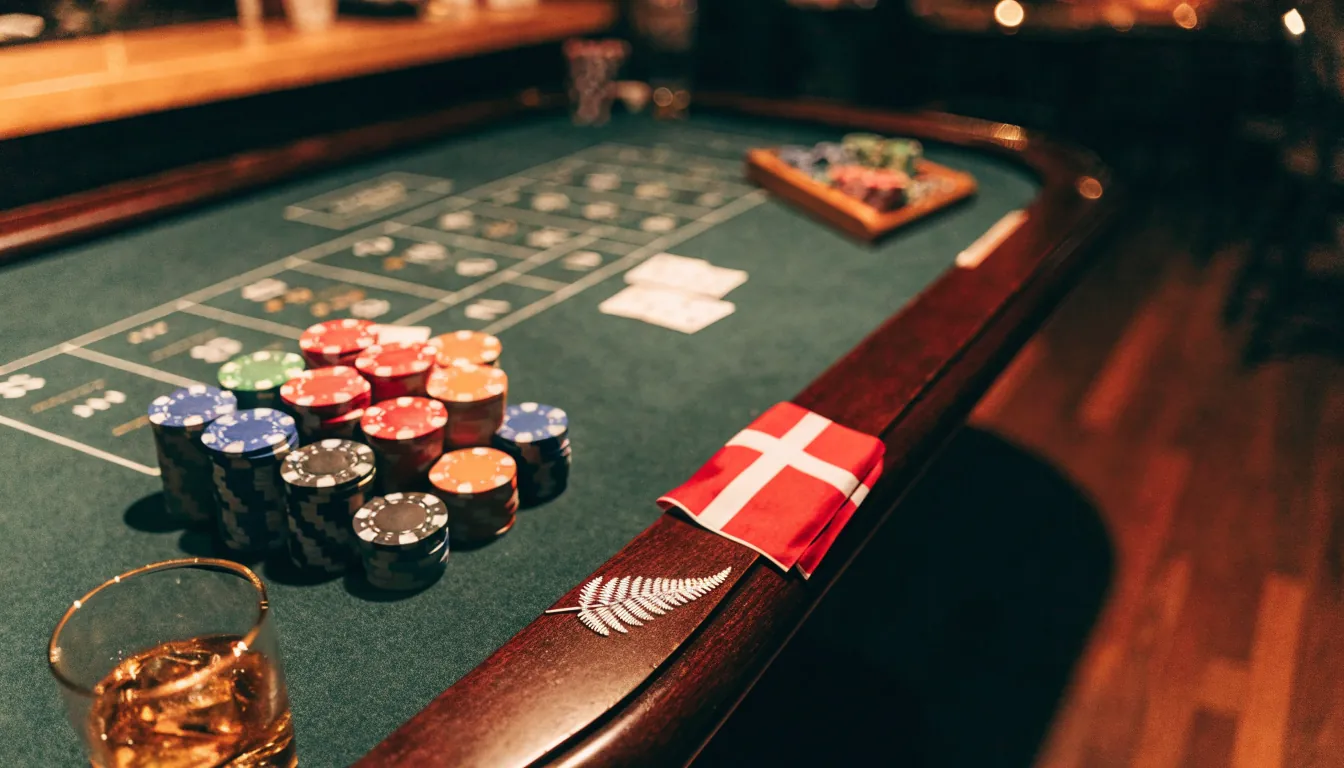
Real-Money Blackjack and New Zealand Dollar Play
The practical difference between real-money blackjack and no-money play is whether a hand puts funds at stake. In a cash game, a wager is deducted from the player’s balance, and a result can change that balance. In a free game, the chips are for play rather than cash wagering. The cards may look similar on screen, but the financial consequences are not.
Play-money blackjack can be useful for becoming familiar with an interface or following a round without putting funds at risk. Its chips should not be treated as cash, and a result in that setting does not establish that the same outcome would occur in a real-money game. A free game with friends is likewise a social activity rather than a way to earn money. The distinction matters when comparing experiences: no-money play removes financial exposure, while real-money play makes each wager consequential.
That difference also limits what can be inferred from practice. A player may learn how a game is presented without spending money, but success with virtual chips does not demonstrate that online blackjack can provide a dependable income. A real-money balance is affected by the results of actual wagers; a play-money score has no equivalent cash value. The two formats can share a visual design without being financially interchangeable.
Choosing a real-money blackjack site in New Zealand calls for checking the available operator information before deciding where to play. This list gives a concise reference point for the details provided about each operator.
-
7Bit Casino
- License
- Tobique Gaming Commission, licence no. 0000091
7Bit Casino is listed with a licence from the Tobique Gaming Commission, number 0000091.
-
Ricky Casino
- License
- Tobique Gaming Commission, licence no. 0000002
Ricky Casino is listed with a licence from the Tobique Gaming Commission, number 0000002.
-
N1 Casino
- License
- Malta Gaming Authority, licence no. MGA/B2C/394/2017
N1 Casino is listed with a Malta Gaming Authority licence, number MGA/B2C/394/2017.
-
BitStarz
- License
- Curaçao Gaming Authority, licence no. OGL/2024/165/0185
BitStarz is listed with a Curaçao Gaming Authority licence, number OGL/2024/165/0185.
-
Play Grand
- License
- Malta Gaming Authority, licence no. MGA/B2C/370/2017
Play Grand is listed with a Malta Gaming Authority licence, number MGA/B2C/370/2017.
-
Wintino
- Payout speed
- 1-3 business days
Wintino is listed with a payout speed of 1–3 business days.
-
Zotabet
- License
- 07017519840
- Payout speed
- 1-3 business days
Zotabet is listed with licence number 07017519840 and a payout speed of 1–3 business days.
-
Lamabet
- Payout speed
- 1-3 business days
Lamabet is listed with a payout speed of 1–3 business days.
-
Neospin
- License
- Tobique Gaming Commission, licence no. 0000064
Neospin is listed with a licence from the Tobique Gaming Commission, number 0000064.
For Kiwis, the currency shown at the table is another practical consideration. Many international online casinos accept New Zealand Dollars, so play in NZD does not incur foreign-exchange fees. When a table and account are denominated in the local currency, the displayed wager and balance can be read without first converting them from another currency. This makes the currency denomination relevant even before considering the outcome of a hand.
A site may accept NZD while presenting other account or cashier options as well. The important distinction is between the currency used for play and the method used to move funds. They are related parts of the transaction, but they are not the same thing: a payment method describes how funds are handled, whereas the table currency describes the unit in which the balance and wagers are expressed.
Payment options reported across online casinos in New Zealand include credit cards such as Visa and Mastercard, debit cards, e-wallets including Skrill and Neteller, and bank transfers. Some also accept PaysafeCard or POLi. These are broad market observations, not a guarantee that every casino supports every method. Availability can differ between operators, and the presence of a familiar payment option does not establish that a particular account can use it.
The currency detail deserves separate attention because payment access alone does not resolve conversion costs. Where an international casino accepts New Zealand Dollars, playing in that currency avoids foreign-exchange fees attached to play. That statement is narrower than saying that every transaction is free of charges: it concerns currency conversion, not any other possible payment or account condition. A payment method and a currency choice should therefore be considered separately rather than treated as one feature.

The phrase “blackjack for real money” can describe a game in which funds are wagered, but it does not by itself tell whether the table is denominated in NZD or another currency. Nor does it identify which payment methods are available. Those details need to be checked as separate conditions of the casino account and table. Likewise, the words “free” or “play money” indicate that the chips are not cash stakes; they do not imply that a virtual balance can later be converted into winnings.
Currency denomination also affects how clearly a player can track the size of a wager. An NZD balance avoids mental conversion between currencies during play, while a non-NZD balance requires the displayed amounts to be interpreted in another unit. This is a matter of clarity, not evidence that a table is more favourable. A local-currency display changes how amounts are represented, not the underlying uncertainty of blackjack outcomes.
The choice between cash and no-money play is therefore not simply a choice between two versions of the same activity. One carries financial consequences; the other offers play without cash wagering. Within real-money play, NZD acceptance can remove foreign-exchange fees associated with playing in another currency, while payment methods determine how funds may be handled. Neither currency nor payment availability, on its own, establishes that a casino is suitable or that blackjack will produce a profit.
RNG Blackjack
Software-run hands that take approximately 15 to 20 seconds from deal to result. These tables may have minimum bets as low as NZ$0.50 or NZ$1.
Live-Dealer Blackjack
Human-led rounds taking 30 to 45 seconds per hand. Minimum bets typically range between NZ$5 and NZ$25, with an estimated data use of 500MB to 1GB per hour.
Blackjack on a Phone: Speed, Stakes and Data Use
A phone can be used for blackjack played with cash, but the practical experience depends on more than whether a game opens on a mobile screen. Hand duration, the table’s minimum stake and the amount of data used during live play all affect what a session demands. Free-play blackjack is different: it uses no cash stake, so it cannot be treated as a real-money session merely because the same game is available in both forms.
The clearest time difference is between software-run hands and live-dealer rounds. A specialist review reports that an RNG hand takes approximately 15 to 20 seconds from deal to result, while a live-dealer hand takes 30 to 45 seconds. These are reported estimates, not a guarantee for every table or session. They nevertheless indicate that a phone session can move at a different pace depending on the format. Faster rounds may mean more decisions in the same period of play; the shorter duration of a hand does not, by itself, say anything about the financial outcome.
That distinction matters when considering a real-money session on a phone. The time spent on each hand is separate from the amount staked, and neither should be inferred from the other. A table with a low entry stake can still involve repeated rounds, while a slower round does not make the money at risk disappear. Hand speed is therefore a practical measure of session pace, not a measure of affordability or value.

The quoted minimums also differ by format. A specialist review reports that RNG tables may have minimum bets as low as NZ$0.50 or NZ$1, whereas live-dealer tables typically set minimums between NZ$5 and NZ$25. These figures describe reported table conditions, not a promise that a particular mobile game will offer those amounts. The minimum is especially relevant on a phone because it establishes the smallest permitted stake at the selected table; it does not establish how much a session will cost overall.
A useful comparison therefore separates three questions: how quickly rounds progress, what the lowest permitted stake is, and whether the session uses live video. Looking only at the displayed minimum can miss the effect of pace. Looking only at hand duration can miss the minimum stake. The figures above give a way to compare the two formats, but do not determine which is suitable for any particular budget or pattern of play.
Live video also has a distinct data cost. A specialist review estimates live-dealer play at approximately 500MB to 1GB per hour. That estimate is relevant when a phone is connected through a metered mobile plan: an extended stream can use a substantial amount of the plan’s data allowance. The figure is an estimate rather than a fixed technical rate, so it should not be read as an exact prediction for every connection or stream. The key practical difference is that live play includes video, whereas the cited hand-duration comparison concerns RNG play against a live table.
For someone comparing mobile blackjack options, the figures support a restrained conclusion rather than a ranking of apps. The available estimates do not establish a single best blackjack app for real-money play. They indicate that RNG tables are associated with shorter reported hands and lower possible minimum bets, while live-dealer tables carry longer reported rounds, higher stated minimums and a notable data requirement. These are format-level comparisons, not claims that every table follows the same schedule or price.
Free blackjack can be useful for experiencing a game without staking cash, but it is not equivalent to playing for money. A session with no cash stake does not reproduce the financial conditions of a real-money table, including its minimum bet. Conversely, moving from free play to a cash table changes the stakes, not the basic mobile considerations of pace and, for live video, data consumption.
The practical assessment is consequently narrow but concrete: reported hand times help estimate pace, reported table minimums show the entry point, and the live-stream estimate signals potential data use. None of these figures identifies an operator, verifies current availability, or predicts the cost of a particular session. They provide a basis for comparing the demands of mobile formats without treating a phone game as automatically inexpensive simply because it is accessible on a small screen.
New Zealand’s Online Casino Licensing Framework in 2026
For Kiwis considering blackjack for real money, the key legal distinction is between where the player is located and where the casino is based. Online gambling is permitted for people in New Zealand when the casino operates from outside the country. The Gambling Act 2003 prohibits online casinos from being based in New Zealand; it does not make a player’s use of an offshore casino illegal.

That position is changing under the Online Casino Gambling Act 2026, which took effect on 1 May 2026. The legislation creates New Zealand’s first domestic licensing system for online casino gambling. It places oversight of that framework with the Department of Internal Affairs (DIA), while the Gambling Commission has the separate function of issuing licences and approving changes to their conditions. The Act provides for a maximum of 15 licences, with the DIA responsible for allocating them.
The change does not mean that every casino serving New Zealand customers became licensed on the Act’s start date. A transition runs from 1 May to 1 December 2026. During that period, online casinos that were already providing services in New Zealand before 1 May may continue operating, subject to the Act’s transitional provisions. The full licensed regime is not expected to be operational until 2027, so the existence of the new law should not be confused with a completed licensing system.
This distinction matters when assessing real-money online blackjack in New Zealand. Before the 2026 Act, overseas online casino gambling was not licensed or supervised by a New Zealand regulator. Customers wagering with offshore sites in that period had no domestic government recourse. The new framework changes the regulatory basis for the market, but its transition provisions determine which providers can continue while licensing is put in place.
From 1 December 2026, providers that have not applied for a licence must stop offering online casino gambling in New Zealand. Those that apply but are declined must also cease their New Zealand operations and leave the market. Unlicensed operation is expected to become an offence around mid-2027, and providers may face enforcement action and fines of up to NZ$5 million. These consequences apply to operators, not to players simply because they use an offshore casino.
The Act also imposes conditions on licensed providers. They must offer spending-limit tools and stronger age and identity checks, and they cannot provide autoplay or accept credit cards or buy-now-pay-later payments. Advertising is permitted only under tight rules, while sponsorships are prohibited. Advertising to people in New Zealand is prohibited during the transition period. These requirements concern provider conduct and do not change the basic distinction between the player’s location and the casino’s location.
In practical terms, a person playing blackjack online for real money should not read “licensed” as a blanket description of every casino available during 2026. The licensing system is being established in stages, and eligibility to operate during the transition depends on having served New Zealand customers before the Act began. The DIA oversees the framework, but the Gambling Commission is responsible for licence decisions and changes to licence conditions. Those roles are related, but not interchangeable.
The legal position is therefore transitional rather than a simple switch from unregulated to fully licensed online casino play. Offshore access remains lawful for players, while the rules governing which providers may serve the market are moving toward a domestic licensing model. For online blackjack, that is the relevant legal context: player access and provider authorisation are separate questions, and the timing of the transition determines how the latter is applied.
How Online Blackjack Play and Bonuses Work
Online blackjack for real money can be delivered through software or through a live-dealer table. The distinction concerns how the game is produced, rather than whether a stake has monetary value. In either format, money is involved when a player places a cash wager; a promotional balance may instead be subject to conditions set by the offer.

In RNG blackjack, software shuffles the cards and generates the game. This allows hands to proceed faster than in live-dealer play, where a dealer handles actual cards and players make permitted decisions through an online interface. A live table also uses video and on-screen information to show the round. These formats therefore provide different forms of delivery: one relies on software, while the other presents a dealer-led game through a stream.
The distinction matters when a promotion is attached to play. A bonus is not necessarily equivalent to withdrawable cash, and its terms determine how it can be used. A specialist review reports that bonus offers may include wagering rules and restrictions on which games qualify. That does not establish that every offer has the same conditions; the relevant terms must be read for the particular promotion.
For blackjack, a game restriction can affect whether wagers contribute towards a promotion’s requirements. If blackjack is excluded, or treated differently from other games, playing it may not satisfy the offer’s conditions as expected. The promotion’s wording is therefore more informative than its headline description. It should specify which games are eligible and explain any wagering conditions that apply. Where the wording does not make the treatment of blackjack clear, the value of the offer cannot be assessed from its advertised label alone.
The game format and the bonus terms are separate considerations. Choosing RNG play does not, by itself, establish that a bonus can be used on that game; nor does selecting a live-dealer table show that its wagers qualify. The applicable promotion rules govern that question. This is relevant whether blackjack is opened through a casino website or an app: the method of access does not replace the terms attached to the bonus.
Understanding Bonuses
Promotional balances may be subject to specific wagering rules and restrictions on which games qualify. It is essential to check if blackjack is excluded or treated differently under the particular offer's terms.
Whether you are playing through software or a live-dealer table, the applicable promotion rules govern whether your wagers count towards requirements.
A cash game without a promotion is more straightforward in this respect. The stake is a real-money wager, and no bonus condition needs to be met for the game to count towards an offer. When a promotional balance is involved, however, the distinction between cash and bonus funds can matter. The terms should explain how each balance is handled and whether blackjack play is subject to restrictions. Without that information, it is not possible to assume that a displayed balance can be withdrawn or used without further conditions.
The phrase “no deposit” also does not describe the full conditions of an offer. It identifies a feature of its funding, but says nothing on its own about eligible games or wagering rules. Those details determine whether blackjack play is permitted under the promotion and what requirements remain before any associated funds can be withdrawn. An offer’s label cannot substitute for its terms.
Accordingly, real-money blackjack and bonus-funded blackjack should not be treated as interchangeable. RNG and live-dealer games differ in how the cards are produced and presented; bonus conditions determine whether either format can be used under a particular offer. The relevant distinction is not simply whether blackjack is available, but whether the specific game and balance are covered by the promotion’s stated rules.
Can Blackjack Produce a Profit Over Time?
A winning session is possible, but it does not establish that blackjack will produce a profit over the long term. The relevant measure is the house edge: the casino’s mathematical advantage across repeated play under specified rules. Even a small edge means that, over time, the expected result favours the casino rather than the player. It does not determine the outcome of any individual hand or session.

A published estimate for an eight-deck game puts the house edge at about 0.43% when perfect basic strategy is used and the rules include a 3:2 payout for a natural blackjack, the dealer standing on soft 17, doubling after a split, no surrender, and resplitting to four hands. That figure describes a particular combination of conditions. It is not a universal rate for every online table, nor a prediction of what any player will win or lose.
Payout terms can materially change the comparison. In the same kind of calculation, replacing the 3:2 natural-blackjack payout with 6:5 adds about 1.4 percentage points to the house edge. The difference is substantial relative to the cited edge under the more favourable payout: a game that appears close to even under one set of terms can give the casino a much larger mathematical advantage under another. The effect concerns expected outcomes over repeated hands, not a guaranteed loss on a particular round.
This is why “making money” can refer to two different things. A player may finish ahead after a short run, because cards and hand outcomes vary. Sustained profit is a different claim: it requires an advantage over the house that persists across play. The cited house-edge estimate does not provide such an advantage; even with perfect basic strategy, the stated conditions leave the mathematical expectation on the casino’s side. Skill in applying strategy can be relevant to the size of the edge, but it does not turn that estimate into a promise of profit.
Nor can a single figure answer how much a player might earn. Actual results depend on the rules, the number of hands played, and the variation in outcomes. The edge is a long-run measure, not an income rate, and it cannot be converted into a reliable personal earnings estimate without information beyond the stated game conditions. A large short-term win can occur without changing the underlying expectation; likewise, a losing spell does not by itself show that the edge has changed.
The sound conclusion is narrow. Blackjack can yield a short-term gain, but the available house-edge figures do not support treating it as a dependable way to earn money. Under the specified eight-deck rules, the expected advantage remains with the casino, and a less favourable natural-blackjack payout increases that advantage. These figures describe the mathematics of the game, not a reliable route to profit.
Strategy Depends on the Table’s Rules
A blackjack decision cannot be assessed in isolation from the table rules. The choices available during a hand—hit, stand, double down or split—are familiar across many versions, but the circumstances in which each choice is useful depend on how the dealer must play and what the table permits. A strategy suited to one ruleset may not transfer unchanged to another.
The dealer’s treatment of a soft 17 is one important distinction. A soft hand contains an ace counted as 11 without taking the total above 21. Some tables require the dealer to draw on soft 17; others require the dealer to stand. That rule affects the dealer’s possible final hand, so it changes the conditions under which a player’s decision is evaluated. The dealer must draw until reaching 17 or more and stop at 17 or above, but the soft-17 rule determines how that boundary applies to a hand containing an ace.

Deck count is another feature to establish before applying a strategy. The number of decks changes the composition of the cards in play and can therefore affect the value of a decision. A general chart or remembered rule is not necessarily appropriate for every table if it assumes a different deck setup. The same caution applies to whether surrender is allowed: a strategy that includes giving up a hand under specified conditions cannot be followed where that option is absent.
These differences matter more than the appeal of a supposed system for making money at blackjack. Hit, stand, double down and split are decisions within a ruleset, not a method for ensuring a win or recovering earlier losses. A sound comparison starts by identifying the rules, then uses guidance that matches them. Without that match, a recommendation may look precise while relying on assumptions that do not apply to the game being played.
For anyone choosing to bet real money online, the table’s displayed rules should therefore be treated as part of the game rather than fine print. In particular, the soft-17 requirement, deck count and surrender option should be checked before relying on strategic advice. These details do not remove the uncertainty of a hand, but they define the conditions under which a decision can be judged. No single “best way” applies independently of those conditions.
- Check the dealer's rule on soft 17 (stand or draw)
- Confirm the total number of decks in play
- Verify if the surrender option is available
- Identify the specific payout ratio for a natural blackjack
Blackjack Apps, Small Stakes and Payout Terms
An app’s label does not establish what a blackjack session costs or pays. For real-money play, the relevant details are the table’s minimum stake and the payout attached to a natural blackjack. A no-money mode is different: it does not put a cash stake at risk, so its results do not show what a cash session would return under the same table terms.
A specialist review reports that minimum bets at RNG blackjack tables can be as low as NZ$0.50 or NZ$1. It reports higher entry points for live-dealer tables, with minimum bets ranging from NZ$5 to NZ$25. These are reported table conditions, not a guarantee that every app offers those amounts. The minimum shown for a particular table therefore matters more than the general label “blackjack app”: a low-stakes software game and a live table may not offer comparable entry costs.
Payout terms also vary by table. A specialist review reports that a natural blackjack may be paid at 3:2 at one table and 6:5 at another. The difference is consequential because the payout applies to the qualifying hand, not to every win. A natural blackjack is therefore not enough, by itself, to determine the amount returned; the table’s stated ratio must also be considered alongside the stake.
This makes app comparisons conditional rather than absolute. A low minimum can make a table accessible at a smaller stake, but it does not establish that the payout is favourable. Conversely, a stated payout ratio says nothing about whether the table’s minimum fits a chosen budget. Both terms need to be read together, and the conditions belong to the individual table rather than to the word “app.”

Neither a low entry stake nor a possible natural-blackjack payout makes the game easy money. A favourable-looking result can occur in a single hand, but it does not turn an uncertain game into dependable income. No-money play can separate familiarity with an interface from financial risk, while real-money play adds the possibility of losing the amount staked. The practical distinction is not merely whether blackjack is available in an app; it is whether the selected table’s minimum and payout terms are clear before cash is committed.
House Money, Side Bets and What the Evidence Establishes
“House money” describes a way of thinking about winnings, not a separate form of blackjack stake. Once an amount is placed on a hand, its origin does not alter the game’s outcome: a wager funded from an earlier win is still exposed to the result of the current hand. Treating it as less consequential can obscure that risk.
The phrase can also appear alongside a reference to a blackjack side bet, but it does not identify what that wager covers or how a winning result is paid. Those details depend on the specific table terms. A side bet should therefore be considered separately from the main hand: its conditions, eligible outcomes and payout need to be clear before any stake is placed. The label “house money” alone establishes none of them.
A distinct, confirmed option at some tables is surrender. Where permitted, surrendering means giving up half of the original bet rather than continuing the hand. It is a decision about the main wager, not a side bet and not a way to protect winnings already treated as house money. Its availability is table-specific, so it cannot be assumed across blackjack games.
These distinctions matter because the language around a wager can suggest more than its terms support. “House money” does not make a stake risk-free, and the presence of a side-bet button does not explain the bet’s conditions. The relevant details are the rules attached to the particular table; without those, no reliable conclusion about a side bet’s value follows from its name alone.
The Deal, the Dealer and the Aim of a Blackjack Hand
A blackjack round begins with two cards dealt face up to each player. The dealer also receives two cards, but one is placed face down. This gives the table a shared starting point while concealing part of the dealer’s hand until the round develops.
The aim is to finish with a total higher than the dealer’s without going above 21. A hand that exceeds 21 is bust, so reaching a high total is not enough on its own: the score must remain within the limit. In a real-money game, these mechanics determine whether a hand wins or loses, but the initial deal does not guarantee a particular result.
After the cards are dealt, players may choose among the actions available at the table. They can take another card, stand on their current total, double down, or split a pair. These options change how a hand proceeds, but the basic comparison remains between each player’s final total and the dealer’s. The dealer’s face-down card means that the full comparison cannot be made from the opening cards alone.
The dealer follows a fixed obligation at the end of the round: a hand worth 17 or more must stand. This applies once the dealer’s total reaches that threshold, including a total of exactly 17. The dealer therefore does not continue drawing past 17, while players’ results are judged against the completed dealer hand.

The sequence is straightforward: cards are dealt, players complete their hands, and the dealer’s total is settled under the standing rule. A player can lose by exceeding 21, or finish below the dealer’s score; a higher total that stays within 21 meets the aim of the hand. That structure is the same whether the game is played casually or for cash.
Live-Dealer Blackjack: Cards, Video and Delays
In live-dealer blackjack, the cards are handled by a person at a physical table rather than generated by a shuffle program. The dealer runs the round, while players use the casino’s online interface to make the decisions available to them. Video and information displayed on screen let the remote participants follow the action as it unfolds.
That arrangement makes live blackjack with real money different in character from a software-based hand. The dealer’s actions and the physical cards form part of the round, while the interface provides the connection between the table and each participant. The screen is therefore not merely displaying a result: it is the means through which players follow the deal and register permitted decisions.
A stream can also introduce delay. The image and the information shown on screen may not arrive at precisely the same moment as events at the table, which can make the sequence feel less immediate than software play. A specialist review has also reported that live-dealer games may carry higher betting requirements. That observation should be treated as a report about some games, not as a fixed feature of every live table.
For real-money live blackjack, the central practical distinction is consequently the presence of a human dealer and a streamed physical game. The online interface still mediates participation, but the pace depends on a live round rather than solely on software handling the cards. Video and on-screen details support that experience; they do not remove the possibility of streaming delay. The format offers a view of the dealer conducting the game, while its timing and table conditions may differ from those of an RNG game.
Can I play online blackjack for real money on my phone in NZ?
Yes. You can play cash-stake blackjack on a phone; check that the table uses the currency and stake limits you want.
Is playing live blackjack online legal in New Zealand?
Yes, provided the online casino is not based in New Zealand.
What is the difference between 3:2 and 6:5 blackjack?
The figures describe the payout for a natural blackjack: 3:2 pays more than 6:5 for the same wager. Switching from 3:2 to 6:5 increases the house edge by approximately 1.4%.
Does blackjack always pay 3:2?
No. A natural blackjack often pays 3:2, but some tables pay 6:5.
Casino Games in New Zealand: An Overview
Content created by the «casinoslotsnz.com» team