
Separate wheel facts from Lightning claims
 Available in US
A grounded guide to wheel layouts, betting odds, feature claims and what available information can establish about play in New Zealand.
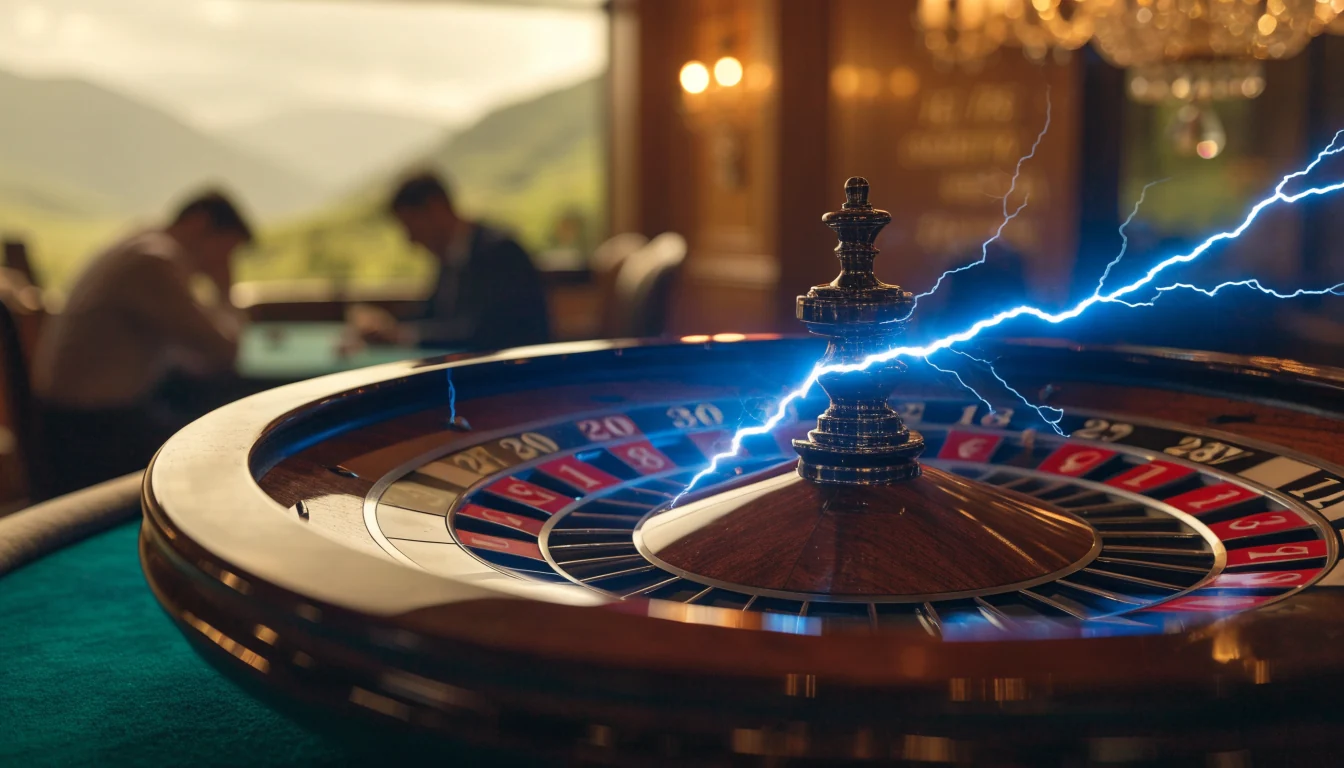
Roulette Numbers, Wheel Layouts and the Lightning Feature
A roulette wheel is divided into numbered pockets, and its layout determines which numbers can appear. European Roulette has 37 pockets: one is zero, and the others are numbered from 1 to 36. American Roulette has 38 pockets, with both a single zero and a double zero alongside the numbered pockets. These layouts are not interchangeable: the extra pocket changes the game’s mathematical profile.
Lightning Roulette is a named roulette variant, but its name alone does not establish how its special feature works. In particular, it does not explain how lightning multipliers are selected, which numbers they may affect, or how any multiplier changes a winning payout. Those details need to be distinguished from the underlying wheel rules. A description of the standard European or American layout cannot, by itself, confirm the specific mechanics of a Lightning Roulette game.
This distinction matters when interpreting references to Lightning Roulette numbers. A number selected for a bet belongs to the wheel’s numbered set, while any additional feature may have its own rules for selecting or treating numbers. The two processes should not be conflated. Without the rules for a particular version, it would be inaccurate to infer that a number is more likely to land because it has been associated with a feature, or that the feature changes the number of pockets on the wheel.

The same caution applies to multiplier claims. A multiplier is not part of the basic definition of European or American Roulette. Its selection method and effect depend on the rules of the particular game. The term “Lightning Roulette” does not provide enough detail to calculate those effects or to state how often a multiplier appears. A game description should therefore be read for its own terms rather than treated as interchangeable with standard roulette rules.
For the standard layouts, the house edge provides a useful point of comparison. European Roulette has a 2.70% house edge, while American Roulette has a 5.26% house edge. These figures describe the respective standard variants; they should not be transferred automatically to a game whose special rules may alter payouts. Nor do they establish the house edge of Lightning Roulette. That figure would require the complete rules for the version being considered, including how its feature affects winning bets.

Questions about placing bets on all numbers also require a distinction between the wheel and the game’s betting interface. The pocket layout identifies the possible outcomes, but it does not establish which combinations a particular Lightning Roulette version permits a player to select at once. Even where multiple selections are available, covering more numbers is not evidence that a bet is guaranteed to win: a spin can still land on an uncovered outcome, and the stake distribution and payout rules matter. The game’s displayed rules determine which selections are accepted.
No number can be identified as the right one to play from the wheel layout alone. Roulette spins are independent, so earlier results do not alter the probability of outcomes on later spins. A run of past results is not a rule for the next spin, and a feature label does not make a number predictable. Tips that imply otherwise go beyond what the wheel’s established structure supports.
The practical way to read Lightning Roulette rules is to separate three questions: which wheel layout is used, what bets and payouts apply, and how the lightning feature operates. The first can be checked against the stated pocket arrangement. The remaining questions depend on the version’s own published rules; they should not be filled in by assuming that every roulette variant behaves alike. Regardless of the format, roulette outcomes are random, every real-money bet can lose, and no more should be risked than can be afforded to lose.
Live and Online Play in New Zealand: The Regulatory Context
A live roulette game and an online casino are different parts of the same regulatory question. The game format describes how roulette is presented; the licensing framework concerns which providers may offer online casino gambling in New Zealand and which public bodies oversee that activity. A live presentation does not, by itself, establish that a provider holds a New Zealand licence or that a particular game is available under the domestic regime.
The Department of Internal Affairs is New Zealand’s primary gambling regulator and oversees the framework for online casino licensing. The Gambling Commission has a distinct licensing role: it considers casino licence applications and makes decisions on them, issues online casino licences, and approves proposed changes to licence conditions. These responsibilities should not be collapsed into a claim that one body performs every licensing function. The Department oversees the framework; the Commission determines applications and administers licensing decisions.
The transition to domestic licensing
The Online Casino Gambling Act 2026 came into force on 1 May 2026, establishing New Zealand’s first domestic licensing framework for online casino gambling. Before that change, online casino services supplied from outside the country were not licensed or supervised by a New Zealand regulator. Customers who wagered with an offshore website during that period had no domestic government recourse in relation to that activity.
The Act includes a transition from the earlier position to the new licensing system. Providers that were already serving people in New Zealand before 1 May 2026 may continue to operate until 1 December 2026, subject to the Act’s transitional provisions. This is a time-limited arrangement, not a statement that every offshore provider is licensed locally. Providers that have not applied for a licence must cease conducting online casino gambling in New Zealand by 1 December 2026.
The full licensed regime is not expected to be operational until 2027. Unlicensed operation is expected to become an offence from around mid-2027, and operators without a licence may face enforcement action and fines of up to NZ$5 million. These milestones describe a staged regulatory change; they do not turn an offshore service into a locally licensed one during the transition.

What this means for live roulette
Terms such as “live casino” describe a mode of presentation, not a separate licensing category. Whether a roulette game is shown with a live dealer or delivered through another online format does not change the need to consider the provider’s legal position under the New Zealand framework. Nor does a game name, including Lightning Roulette, establish which company supplies it, where it is hosted, or whether it is currently offered to New Zealand customers.
The same distinction applies to a search for a particular multiplier or feature. A number attached to a game name is not evidence of a licence, a regulatory approval, or a condition imposed by the Gambling Commission. Those matters concern the provider and its permissions, whereas game-specific mechanics concern the product itself.
During the transition, advertising online casino gambling to people in New Zealand is prohibited. Accordingly, regulatory information should not be treated as an endorsement or invitation to use a particular service. The licensing framework also requires licensed operators to implement stricter age and identity verification systems. These are regulatory safeguards attached to licensed provision; they do not establish that every service accessible online is licensed or subject to those safeguards.
For New Zealand, therefore, “online casino” and “live roulette” are not sufficient descriptions of a provider’s legal status. The relevant distinctions are whether the provider falls within the transitional provisions, whether it has applied for a licence when required, and whether it ultimately operates under the domestic licensing regime. The roles of the Department of Internal Affairs and the Gambling Commission define how that regime is overseen and administered, without determining the rules or availability of any individual roulette game.
First Person Lightning Roulette: What the Available Facts Establish
“First Person Lightning Roulette” is a distinct game name, but the wording alone does not establish how the game is presented or played. In particular, “First Person” should not be treated as proof of a specific camera angle, control scheme, screen layout or relationship between the player and a live presenter. Those details depend on the actual product and cannot be inferred from its title.
The same distinction applies to rules. General roulette terms describe the underlying wheel and bets; they do not, by themselves, establish the rules of a separately named game. The title does not specify how a round begins, which betting options are offered, how any Lightning feature works, or how a winning selection is settled. Those details require product-specific rules. Without them, assumptions based on another roulette game bearing the Lightning name may be misleading.
A similar caution applies to the game’s interface. The name does not say whether play is shown from a first-person viewpoint, whether the display is animated or live, or how the table is arranged on screen. It also does not establish whether the game can be accessed on a particular device. These are features of a specific implementation, not consequences of the words in the title.

The term “RTP” refers to a game’s theoretical return to players over a large volume of play, not a forecast for an individual session. A figure associated with another roulette variant cannot be assigned to First Person Lightning Roulette solely because the games share part of a name. Nor can a theoretical return figure establish the outcome of any particular round. Product-specific published information is needed before an RTP claim can be assessed.
Questions about payment by phone or a site’s payment methods are separate from the game’s rules. A game title does not confirm which payment options a website accepts, whether a particular method is available in New Zealand, or what conditions apply to deposits and withdrawals. Likewise, the existence of a named game does not establish that a particular site offers it. Naming websites as if they provide this format would require current, product-specific confirmation.
The phrase “not on GamStop” refers to a UK-focused self-exclusion context; it is not evidence about the game’s mechanics or its availability in New Zealand. A self-exclusion label, where relevant to a service, should not be read as a description of the game itself. It also cannot establish the regulatory position of a website for New Zealand residents.
For the game to be described reliably, its own rules and product information would need to identify its presentation, available bets, feature mechanics and any published return figure. Website-level details would need to be checked separately. Until those distinctions are clear, the name supports only the identification of a separate roulette variant; it does not justify claims about its interface, availability, payment methods or specific rules.
Roulette outcomes remain random, and each real-money bet can lose. No presentation style or game label changes that uncertainty. Anyone choosing to gamble should not risk more than they can afford to lose.
Roulette Odds and the Limits of Betting Strategies
A betting strategy can organise how stakes are placed, but it does not, by itself, improve the underlying odds. The relevant comparison is between the rules attached to a bet and the chances of its possible outcomes. Changing stake size or the order of bets cannot alter those rules.
French Roulette provides a clear example of how table rules affect the odds. When La Partage or En Prison applies, the house edge for eligible even-money bets is 1.35%. These rules soften the effect of zero on those bets: La Partage returns half the stake when zero lands, while En Prison carries the bet forward under its own settlement rule. French Roulette therefore offers the best odds for even-money bets among the variants covered by these rules. The advantage comes from the rule, not from a betting system.
La Partage does not apply to every wager. Its effect is confined to eligible even-money outside bets when zero lands. A strategy that places different bets, or varies the stake from one spin to another, does not extend that protection to other bet types. The distinction matters because a table’s stated rules determine the mathematical terms; a staking pattern cannot substitute for a favourable rule.
Searches for a best Lightning Roulette strategy often imply that a particular sequence can overcome the game’s disadvantage. That claim should be treated cautiously. A strategy may set out when to place a bet, how much to stake, or when to stop, but those instructions do not establish a mathematical edge. Nor does the label “strategy” show that a method can beat Lightning Roulette. Any claim of an advantage would need to rest on the game’s actual rules and odds, rather than on a prescribed betting sequence.

This also limits what can be inferred from systems that increase stakes after losses or reduce them after wins. Such approaches change the distribution of stakes across play, not the probability structure of the game. A sequence of favourable outcomes can produce a gain, and an unfavourable sequence can produce a loss; neither result demonstrates that the system has changed the house edge. No betting system removes that edge, and no method can guarantee a winning session.
The term “best odds” therefore has a narrower meaning than “best strategy.” It refers to the mathematical terms created by a game’s rules, such as the reduced house edge on eligible French Roulette bets when La Partage or En Prison applies. It does not mean that every session will be profitable or that a betting method can secure a particular outcome. A real-money bet can lose, regardless of the staking plan. Roulette outcomes are random, so no strategy makes them certain or predictable. Any play should remain within an amount that can be afforded to lose.
How Roulette Bets Work—and Why No System Guarantees a Win
A roulette bet records a chosen outcome before the wheel is spun. It does not influence where the ball lands. This distinction matters when assessing claims about how to win at Lightning Roulette: a betting pattern can organise stakes, but it cannot make a future result more predictable. Roulette spins are independent, so earlier results do not alter the probability of outcomes on later spins.
A run of the same colour, a sequence of alternating results or a number that has not appeared recently may look significant when viewed as a record. None of these patterns changes the next spin. The wheel does not compensate for previous outcomes, and a player cannot make a result “due” by waiting or changing the size or placement of a bet. A sequence can continue, end or change; its past appearance does not determine which will happen.
This limits what can responsibly be called the best way to bet on Lightning Roulette. A method may set rules for when to place a bet or how much to stake, but no such rules guarantee a win. A system that increases a stake after a loss, for instance, does not alter the next spin’s probabilities. It can instead expose more money to risk. Covering more possible outcomes also does not turn a wager into a certainty: every real-money bet can lose.
The same reasoning applies to attempts to predict results from a tracking record. A list of prior spins can describe what has happened, but it cannot establish what the next spin will produce. Software, charts or personal observations do not change the independence of the outcomes. Nor does using an app to place bets give a player an informational advantage about where the ball will land. The availability or features of a particular app are separate questions from the probabilities of roulette.

Requests for ways to cheat Lightning Roulette concern interference rather than betting. There is no basis here for treating a supposed trick, prediction tool or betting sequence as a reliable route to a result. Claims that such methods can control or foresee a spin should not be confused with an explanation of how roulette bets work. In particular, a confident claim is not evidence that the underlying outcome has become less uncertain.
A useful distinction is therefore between managing decisions and predicting results. A player can decide in advance which bets to make, when to stop and what amount is affordable to lose. Those choices can limit exposure, but they do not control the wheel. No betting system removes the possibility of losing, and no sequence of earlier wins makes a later wager safe.
Roulette remains a game of chance even when a betting method is applied consistently. The soundest description of any system is that it structures wagering, not that it guarantees profit or predicts the next spin. Money placed on a real-money roulette bet should be treated as at risk, and no more should be risked than can be afforded to lose.
Free Online Play: What Can Be Confirmed
“Free play” can refer to a version of a casino game that does not involve staking real money, but the label alone does not identify how a particular title works. It does not establish whether Lightning Roulette has a free mode, whether that mode uses the same rules as real-money play, or whether any conditions apply. Those details should not be inferred from the game’s name or from a general description of roulette.
Free Play vs Real Money
Free versions do not guarantee the same rules or availability as real-money games.
A practice setting does not demonstrate that real-money play is available in a particular place, nor does it confirm the specific terms of play.
The distinction matters because a free version, if offered, and real-money play are different arrangements. A practice setting would not by itself demonstrate that real-money play is available in a particular place, nor would it confirm the terms under which any such play is provided. Conversely, a listing or reference to the game does not establish that it can be played without a stake. Claims about access need to be tied to the specific version and its stated conditions.
The same caution applies to payout descriptions. A payout figure has meaning only when the rules and bet type are clear. Standard roulette variants have different wheel layouts and house edges; a payout description for one variant should not automatically be applied to another. In particular, a general roulette payout table does not establish Lightning Roulette’s specific payout rules or the terms of any free-play version. A headline figure without that context can be misleading.
Free play also has limited value as a guide to outcomes. A run of simulated spins cannot predict future results, and previous results do not change the probability of later spins. Any display of past outcomes is a record of what has already occurred, not evidence that a particular number or bet is becoming more likely. If real money is involved, every bet can lose, and no pattern or staking approach can guarantee a return.
The question of where a game can be played is separate from whether it has a free mode. A title’s presence in a catalogue, a promotional description, or an access link does not by itself establish the legal or commercial terms of play. Nor does a free-play label confirm that the same game is available for real-money wagering. These are separate claims and require separate evidence.

Accordingly, “Lightning Roulette free play online” describes an intended kind of access, not a confirmed feature or a promise about its conditions. Any description of a free version would need to identify what is actually offered, whether money is staked, and how its rules relate to the named game. Without those details, it is not sound to treat free play as a substitute for real-money play or as proof of a particular payout. Real-money roulette remains a form of gambling with uncertain outcomes; spending should never exceed what can be afforded to lose.
Bonuses, Tracking and Prediction Claims
A Lightning Roulette bonus is governed by its stated terms, not by the roulette feature itself. In New Zealand, advertised casino bonuses may carry eligibility conditions, wagering requirements, expiry dates, game-contribution rules and restrictions on withdrawals. These conditions determine whether a promotion applies and what must happen before bonus-related funds can be withdrawn. A headline offer alone does not describe those obligations.
The wagering conditions are material. Bonus money must be wagered 50X within 30 days, while winnings from free spins must be wagered 50X within 7 days. A withdrawal request voids all active or pending bonuses. These requirements can affect the value and availability of promotional funds, so a bonus should not be treated as cash with unrestricted access. The terms may also distinguish which games contribute towards wagering, whether eligibility is limited, and when an offer expires.
DO
- Check the specific terms and conditions of a bonus.
- Verify the operator's licensing status.
DON'T
- Assume a game name confirms availability or specific mechanics.
- Use a betting system to attempt to overcome the house edge.
Bitcoin and Lightning Roulette refer to different things: Bitcoin is a payment-related term, while Lightning Roulette is a roulette game variant. Mentioning both together does not establish that a particular operator accepts Bitcoin, that a bonus applies to Bitcoin transactions, or that a payment method changes the game’s outcomes. Any claim about payment compatibility or bonus eligibility depends on the relevant operator’s published conditions.
Tracking roulette results can describe what has happened, but it cannot make earlier spins influence later ones. Roulette spins are independent, so a sequence of past results does not change the probability of an outcome on a future spin. A record may help organise past observations; it is not evidence that a number is due or that a pattern will continue.
The same distinction applies to prediction tools. A roulette predictor may present calculations or historical records, but those do not alter the independence of spins. A prediction based on previous outcomes cannot guarantee the next result, and no bonus term changes that underlying uncertainty. Promotional wagering requirements concern how funds must be played through; they do not provide information that makes a future roulette result predictable.
Claims about “tracking” or “prediction” should therefore be assessed by what they actually measure. A display of previous results is a record, not a mechanism for controlling or foreseeing the next spin. Separately, bonus conditions govern eligibility, wagering, expiry and withdrawal. Neither category should be confused with a method of changing roulette probabilities.

Roulette Results and Statistics: What the Numbers Can Show
Reported roulette statistics can describe a game’s theoretical return, but they do not predict the result of a particular spin. A payout percentage expresses the proportion of stakes expected to be returned over extensive play under the rules being assessed. It is not a promise that an individual player, or any short session, will receive that proportion.
A specialist review reports payout percentages of 94.70% for American Roulette and 97.30% for European Roulette. These figures are useful as a comparison presented by that review, rather than a guarantee for every table or version. Rules and game specifications matter when interpreting a published percentage; a number without that context may not describe the game being played.
The same caution applies to 100/1 roulette. A specialist review places its payout percentage between 92.86% and 96.19%. The range should not be treated as a single universal rating: it indicates that the reported figure varies across the versions covered by the review. Comparisons are meaningful only when the underlying rules and calculation method are clear.
Statistics about past results require a separate interpretation. Roulette spins are independent, so previous outcomes do not change the probability of any outcome on a future spin. A sequence of results may be recorded and summarised, but it cannot establish that a particular number, colour or group is now more likely to appear. Historical results describe what has happened, not what the next spin will produce.
That distinction is important when assessing claims about Lightning Roulette results or statistics. A results record could document outcomes from a particular run, but it would not by itself demonstrate a recurring pattern or establish future probabilities. Nor should the game’s name be confused with a slot: roulette remains a wheel-based game, and a statistic describing another format would not automatically apply to it.
Can statistics predict future results?
No, statistics and past results describe what has happened, but they cannot predict the outcome of a single future spin.
Does a payout percentage guarantee a win?
No, a payout percentage is a theoretical return over a large volume of play and is not a guarantee for an individual session.
A meaningful comparison therefore needs a defined game, its rules and a clearly explained basis for the percentage. Figures from reviews can provide context, while recorded outcomes can describe past play. Neither turns a historical sequence into a forecast. Any real-money roulette bet can lose, and no result table changes the independence of future spins.
Lightning Roulette Demo Play and the Limits of the Evidence
A request for a Lightning Roulette demo concerns a specific way of accessing the game, not simply its roulette rules. The word “demo” commonly signals a version intended for play without placing real-money bets, but the label alone does not establish how a particular title is presented or whether such a version is offered.
It would therefore be unreliable to describe a practice balance, say that registration is or is not required, or claim that a demo reproduces every feature of real-money play. Those details depend on the specific version and its provider, and should not be inferred from the game’s name.

The same caution applies to claims that demo play reveals how often special features appear or helps predict future results. Roulette spins are independent: previous outcomes do not change the probability of outcomes on later spins. A sequence observed in a practice setting cannot establish what will happen on a subsequent spin, and familiarity with a format is not evidence of an advantage.
A free demo, if offered for a particular title, should also be distinguished from a promise of cost-free access under every condition. The term by itself does not specify whether access is open, temporary, or subject to other requirements. Without details tied to the actual offer, those conditions should not be assumed.
Demo play and real-money play are not interchangeable. Practice may allow a person to become familiar with a game presentation, but it cannot establish the financial outcome of later bets. Real-money roulette outcomes remain random, and every such bet can lose. Anyone who chooses to play should not risk more than they can afford to lose.
Lightning Roulette Online in 2026: What Is Known
Lightning Roulette combines live roulette with lightning-themed features, so choosing a casino is also about checking the details available for each operator. This list offers a concise reference for readers in New Zealand looking into the game in 2026.
-
7Bit Casino
- License
- Tobique Gaming Commission, licence no. 0000091
7Bit Casino lists a licence from the Tobique Gaming Commission, number 0000091.
-
Ricky Casino
- License
- Tobique Gaming Commission, licence no. 0000002
Ricky Casino lists a licence from the Tobique Gaming Commission, number 0000002.
-
N1 Casino
- License
- Malta Gaming Authority, licence no. MGA/B2C/394/2017
N1 Casino lists a Malta Gaming Authority licence, number MGA/B2C/394/2017.
-
BitStarz
- License
- Curaçao Gaming Authority, licence no. OGL/2024/165/0185
BitStarz lists a Curaçao Gaming Authority licence, number OGL/2024/165/0185.
-
Play Grand
- License
- Malta Gaming Authority, licence no. MGA/B2C/370/2017
Play Grand lists a Malta Gaming Authority licence, number MGA/B2C/370/2017.
-
Wintino
- Payout speed
- 1-3 business days
Wintino is listed with a payout speed of 1–3 business days.
-
Zotabet
- License
- 07017519840
- Payout speed
- 1-3 business days
Zotabet lists licence number 07017519840 and a payout speed of 1–3 business days.
-
Lamabet
- Payout speed
- 1-3 business days
Lamabet is listed with a payout speed of 1–3 business days.
-
Neospin
- License
- Tobique Gaming Commission, licence no. 0000064
Neospin lists a licence from the Tobique Gaming Commission, number 0000064.
Lightning Roulette’s online availability in New Zealand in 2026 cannot be inferred from the game’s name or from changes to the country’s gambling laws. The legal position for online casinos changed during the year, but that change does not establish whether this particular roulette game is offered, by whom, or under what game-specific conditions.
The Online Casino Gambling Act 2026 took effect on 1 May 2026 and created New Zealand’s first domestic licensing framework for online casino gambling. A transitional period runs from that date to 1 December 2026. During this interval, providers that were already serving New Zealand customers before the Act began may continue operating, subject to the transition rules. The full licensing regime is not expected to be operational until 2027.
This market context should not be mistaken for confirmation of Lightning Roulette’s presence on any online casino. Nor does a provider’s ability to continue during the transition establish that a particular game is included in its offering. Game availability and specific online conditions require confirmation from current, game-specific information.
The distinction matters because the regulatory framework concerns providers and their permission to operate, while the game title identifies a product. Those are separate questions. The legislation does not, by itself, verify the game’s New Zealand availability or describe how it works online.
Before the domestic framework was introduced, online casino services supplied from outside New Zealand were not licensed or supervised by a New Zealand regulator, and customers had no domestic government recourse when wagering with an offshore site. In 2026, the transition changes the regulatory setting for eligible providers, but does not support a general claim that Lightning Roulette is available across the market. Claims about its online status should therefore be limited to specific, current confirmation.
Casino Games in New Zealand: An Overview
Content created by the «casinoslotsnz.com» team